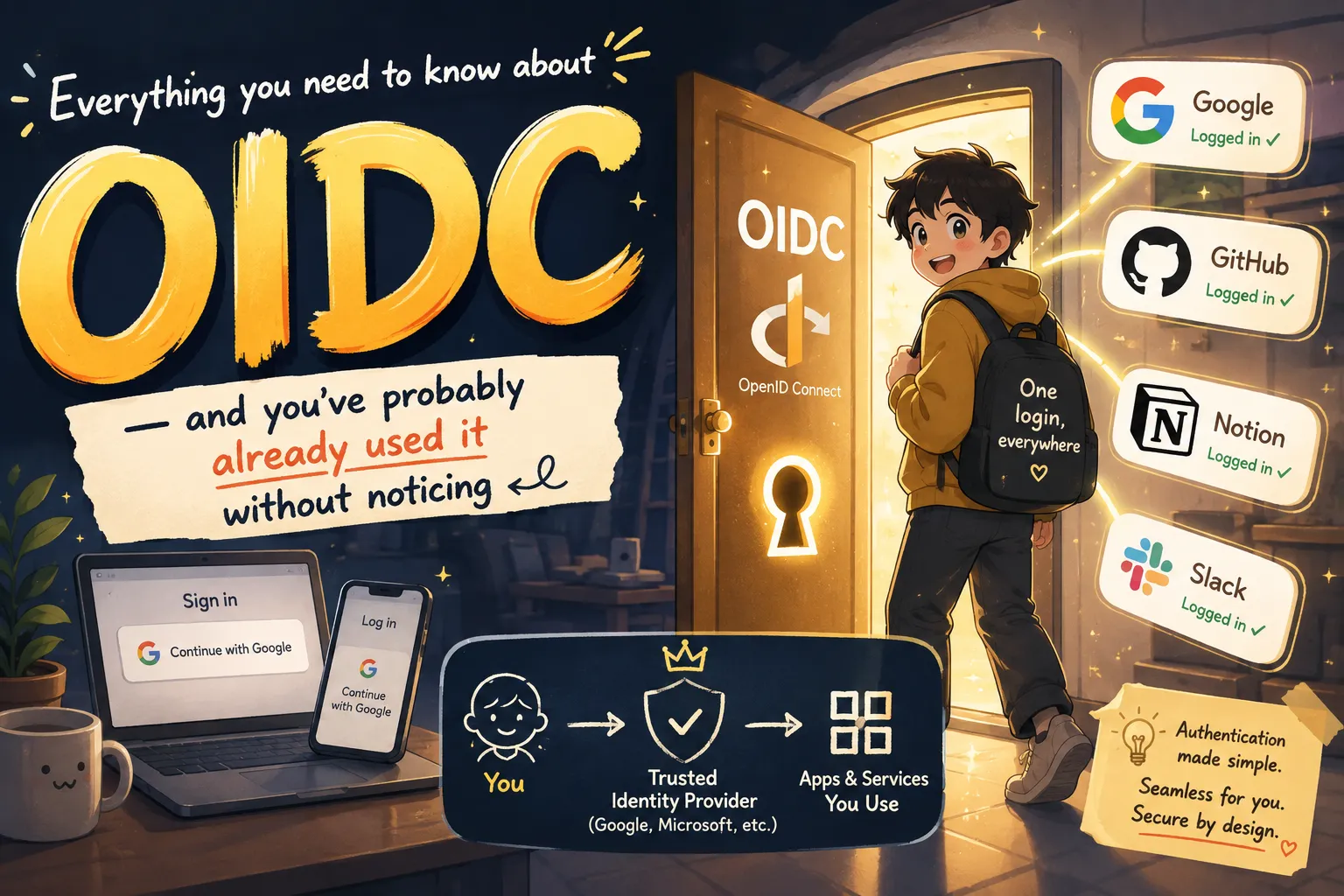
When I was initializing CI/CD, an AI told me to stop putting long-lived AWS keys in my CI secrets and use OIDC instead, because it’s “safer.” That’s the kind of sentence I don’t like taking on faith. Safer how? Against what? So I questioned it and dug in.
Turns out the mechanism is quite straightforward. And by the end I realised I’d been using it for years — every “Log in with Google” button is the same thing.
Before and after
Here’s what I was about to build, and what I built instead.
Before: generate an IAM user, copy the access key and secret into CI secrets, reference them in the workflow.
env:
  AWS_ACCESS_KEY_ID: ${{ secrets.AWS_ACCESS_KEY_ID }}
  AWS_SECRET_ACCESS_KEY: ${{ secrets.AWS_SECRET_ACCESS_KEY }}
That key never expires. It works from any machine on earth. It’s now in CI secrets, in whoever’s password manager, and possibly in a Slack thread from onboarding. If it leaks, you find out later.
After: no key anywhere, and the temp credentials only live for, say, 10 minutes;
permissions:
  id-token: write
steps:
  - uses: aws-actions/configure-aws-credentials@<commit-sha>
    with:
      role-to-assume: ${{ vars.AWS_ROLE_ARN }}
      aws-region: ${{ vars.AWS_REGION }}
The three parties
- Issuer (also called provider, or IdP — same thing) signs a short-lived token with their private key, proving it really came from them
- Courier carries it (the middleman)
- Verifier checks the signature and grants access — it knows what to expect, and has the public key to verify
For a GitHub Actions deploy to AWS: GitHub is the issuer, the runner is the courier, AWS is the verifier.
Plenty of others sit in that issuer slot: GitLab CI, CircleCI, Bitbucket Pipelines, Google, Microsoft Entra ID, Okta, Auth0, Kubernetes service accounts. Any service publishing its config and public keys at a well-known URL can be one.
The part that took me a moment: the issuer and the verifier never talk to each other. GitHub does not know your AWS account exists. The runner is the only thing that touches both.
AWS does fetch something from GitHub once, but it’s GitHub’s public keys from a public URL. Nothing secret is exchanged. GitHub holds the private key. AWS holds nothing at all.
🛂 It’s just a passport at a border
- The token is the passport
- GitHub is the government that issued it
- The runner is the traveller, carrying it
- AWS is the officer at the border, verifying the passport
The officer doesn’t phone the government. He trusts the signature, and reads three things off the document.
What the officer reads
Your name — subject (sub)
GitHub prints this from the real job:
repo:MY-ORG@111111/MY-REPO@222222:ref:refs/heads/develop
Three parts. Owner, repo, branch. And the two @ numbers are the interesting bit.
🔒 Why the IDs make it unforgeable
Owner and repo names are globally unique at any given moment — nobody else can create your org’s repo while it exists. But names are recyclable. Delete a repo, rename an org, let a username lapse, and the name is free for anyone to take.
That used to be a real hole. Whoever grabbed the freed name could create a repo with the same name, and mint tokens whose sub was character-for-character identical to yours. Any cloud role still trusting that string would happily let them in.
The numeric IDs close it. 111111 is the owner ID, 222222 is the repository ID, and IDs are never reused. Delete the repo and recreate it with the same name, and it gets a fresh repo ID — so its tokens no longer match. Lose the org name to someone else, and they get a different owner ID.
So the identity isn’t “a repo called this.” It’s “that repo, the one that exists.” Names can be re-registered; IDs cannot be re-issued.
And underneath all of it, the property that actually matters: the job cannot write its own**sub**. It asks for a token and receives one already filled in.
Your visa, which country it’s for — aud
A token minted for one service can’t be replayed at another. AWS expects sts.amazonaws.com. GCP expects its own workload identity provider path. Vault expects whatever you named the audience there.
What we configure on the cloud side
Two things, and they answer different questions.
One — register the issuer. Once per account. “Tokens signed by this URL are readable here.” This grants nothing by itself.
resource "aws_iam_openid_connect_provider" "github" {
  url            = "https://token.actions.githubusercontent.com"
  client_id_list = ["sts.amazonaws.com"]   # audience allowlist
}
No certificate thumbprint needed anymore — AWS validates GitHub’s endpoint against its own trusted CAs.
Two — the role’s trust policy. “This exact job may become this role.” This one is the security boundary.
condition {
  test     = "StringEquals"
  variable = "token.actions.githubusercontent.com:sub"
  values   = ["repo:MY-ORG@111111/MY-REPO@222222:ref:refs/heads/develop"]
}
StringEquals, not StringLike. A wildcard like repo:MY-ORG/*:* hands the deploy role to every branch, tag and pull request in that repo — and a wildcard on the org hands it to every other repo too. That single character is the entire attack in more than one public write-up.
Pass the provider check but fail the trust policy, and you’re denied. The provider alone opens nothing.
🔐 So why is it actually safer?
Back to my original question. Four properties are doing the work:
1. Nothing is stored, so there’s nothing to steal at rest. The credential doesn’t exist until a job asks, and stops existing shortly after.
2. The caller can’t name itself. If I could keep only one property, this is it. The issuer writes the identity from real job metadata; the verifier decides whether to accept it. The asker gets no say in either.
3. The verifier holds no secret. AWS only has a public key. Compromise AWS’s copy and you get nothing — you can’t forge a signature with a public key. Compare a shared secret, where a leak on either side is fatal.
4. Audience binding blocks replay. A token for one service is useless at another.
And the framing that made it click: big organizations trust each other without ever sharing a secret. Nobody hands over the key to print passports. They publish what a valid signature looks like, and check at the border.
⚠️ Where “safer” stops
I set out to test a claim, so it’d be dishonest to stop at the good part.
- A leaked token is still a bearer token for its lifetime. Anyone holding it in that window can use it from anywhere. What shrinks is the window — forever, to minutes. Real win, smaller claim than “unstealable.”
- Same for the credentials it returns. Around an hour by default, sitting in the runner’s environment, readable by anything running in that job — including a third-party action you pulled in. Pin actions to a commit SHA, not a mutable tag.
- It authenticates the run, not the human. It proves the job ran on that branch of that repo. It does not prove the change was reviewed.
- The role’s permissions are a separate question. A perfectly pinned trust policy on a role that can do anything is a perfectly authenticated path to doing anything.
Safer, yes — and now for reasons I can name. Not magic.
You’ve already used this
“Log in with Google” is the same three parties. Google issues a signed token about you, your browser carries it, the app verifies it against Google’s public keys. The app never sees your password. Google never calls the app.
sub is your Google account ID — a number, not your email, for exactly the reason above: emails get recycled, IDs don't. aud is the app's client ID, which is precisely why one app can't take your token and replay it at another.
Same shape, different names. Only the issuer and the sub format change — and the sub format is the only reason a trust policy has to be written per-issuer.
TLDR;
- OIDC is a signed note about who is asking, good for minutes.
- Three parties: issuer signs with a private key, courier carries, verifier checks with the public key. Issuer and verifier never talk to each other.
- Token = passport, GitHub = the government, runner = the traveler, AWS = the officer.
- The asker can’t write its own name. The issuer writes it, the verifier decides. That’s the whole security boundary.
- Unforgeable because
subcarries immutable owner and repo IDs — names can be recycled, IDs never are. - The branch has no ID, so branch protection is the other half of the story.
audis the only field the caller picks, which is exactly why it must be verified.- Before: a key that never expires, stored in three places; After: no key at all.
- Pin
subwithStringEquals. Pin actions to a SHA. Scope the role.