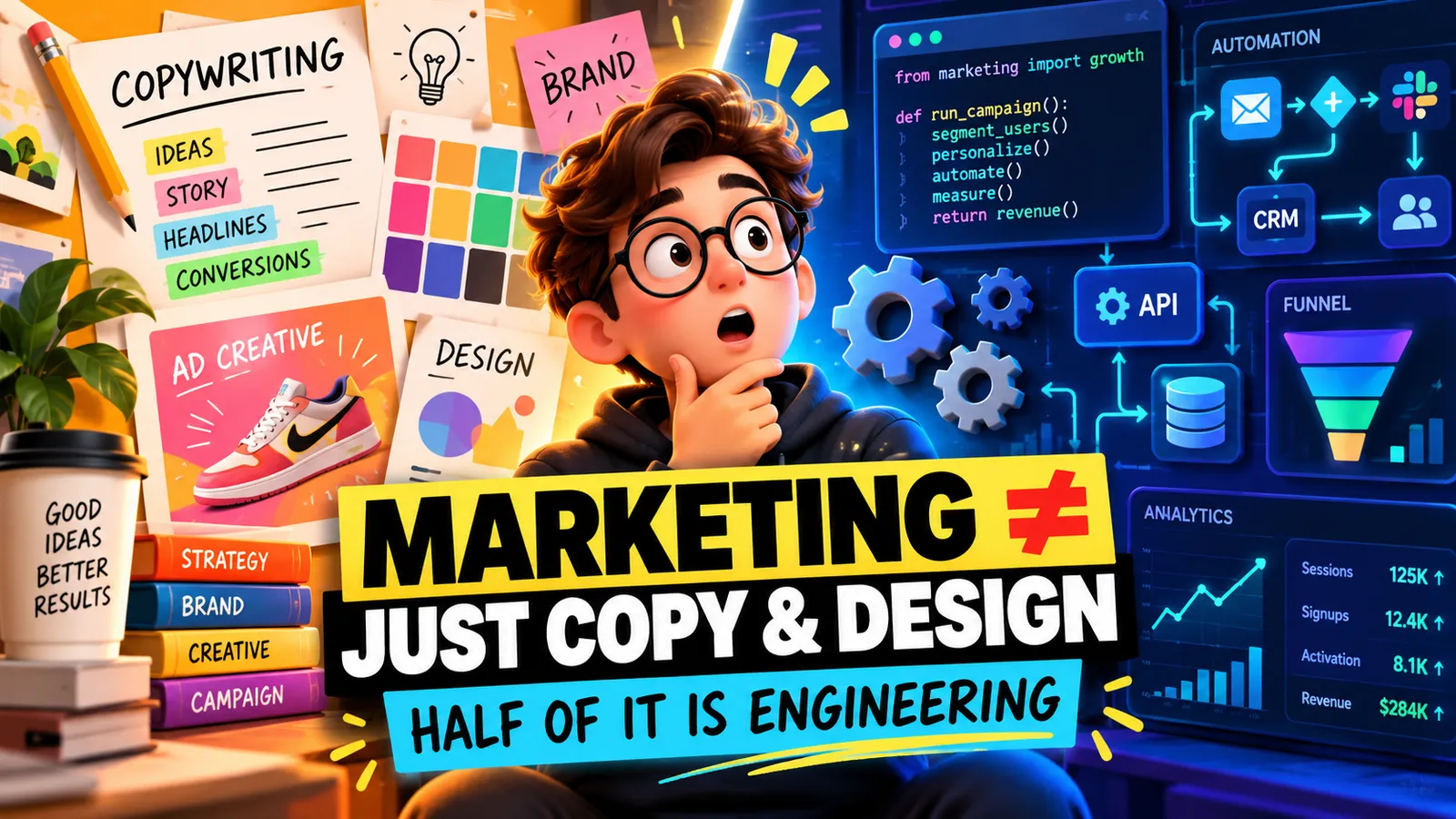
Say today the goal is to get exposure for the company and increase the number of customer sign-ups.
And say we use Meta Ads. The whole picture in my mind when I imagine it: brainstorm the overall ad idea and define a clear goal > decide on and design the medium (image, video) > come up with scripts and such > launch the ads. Done, right?
No, not really. We can’t just put out ads and expect everything to work well. There’s no “magic” behind it, and we have to figure things out.
Think about it:
- How do you “teach” Meta Ads to learn patterns better so it brings you a better audience?
- How do you collect data to prove which ad set works better?
- How do you define a custom success metric that isn’t predefined in Meta but suits your business?
- How do you feed the existing information you have into Meta and have it learn from it?
The Marketing team’s Expertise
The marketing team is good at copywriting, has a strong design sense (image or video editing), knows what catches the audience’s eye, and knows what’s trending. This kind of intuition is what a marketer has, professionally.
However, letting marketers focus on their expertise, or even laying the foundation to fully use this skill set, requires a solid data source: data that is correctly collected and presented, and reliable enough to be trusted.
Example: We all know about A/B testing. In an ideal world, we’re always presented with a scenario like: “Hey, design A drove 1,000 clicks, while design B drove 2,000 clicks, so design B is better.” It’s so obvious that any of us would know what to do. But how do you guarantee that the 1,000 and 2,000 clicks were accurately collected and aren’t duplicates or spam? If the data is fundamentally wrong, it could lead marketing in the wrong direction and end up optimizing for the wrong goals.
Example: We had traffic coming into our webpages, and we knew that if we able to stitch it together, it would give the business meaningful insights. But question is, how do we correlate it reliably? How can we ensure that there are no repeated events?
That’s where engineering comes in.
- We’re best at making sure the logical flow behind the big idea gets executed accurately.
- We know how cookies are generated and how they persist within the same domain.
- We know how to pass them across different domains, how to test them, how to simplify the flow, and so on.
That’s our day-to-day job and exactly our field of expertise.
Common Marketing Tools today
- Google Tag Manager — Do you know what it really does? What does “Manager” means? “Tag” means scripts, so what do the scripts do? What’s the mechanism behind the scene? Cookie? And why they are used?
- Google Tags? GA4? Site Kit? SEO/AEO? Google Search Console?
If you have used Meta Ads before and have published some ads:
- Do you know how to manage custom conversions?
- How to integrate CAPI?
- Where to put Pixels?
- How to avoid data duplication?
- How Meta ads gets better?
- How to tell Meta that these are the audiences that we want?
Then, once you’ve figured that out, the trickiest part is: how do you implement them? How do you test them? In the process, how do you ensure it doesn’t affect other working features?
Imagine lacking engineering skills here: the data could be unreliable, and marketing may have ideas on how to improve the ads but be technically slow or blocked from implementing them.
Imagine lacking marketing skills; Although the data is reliable, we’d have no idea how to proceed further for growth, or why design A does better than design B. Sometimes a slight copy or asset change can make a big difference, and we wouldn’t be able to spot it.
That’s why both should work together: engineering lays down the foundation, gets advice from marketing, launches experiments with marketing, and both grow together.
When you dive deeper, you’ll realize that doing a “marketing” role end to end requires marketing skills + technical engineering skills. Together, they are the cornerstone of a company’s successful growth.
TL;DR: Marketing skills + Technical skills = Higher success rate in growth 😼